

In a year marked by geopolitical fragmentation, regulatory overload and shifting power in the midstream of global supply chains, the LCTA Annual General Meeting and Commodity Roundtable in Lugano offered an unvarnished look at the forces reshaping the trading world

Industry leaders dissected a global economy at peak interdependence yet rising vulnerability, warned of Europe’s self-inflicted competitiveness trap, and underscored how processing capacity—not the availability of raw materials—has become the real geopolitical lever. From Switzerland’s evolving role as a stability hub to the slow march of digitalization and the enduring dominance of the dollar, the roundtable captured a sector navigating (little) volatility and slow pace not as a disruption, but as its new operating rhythm.

After a closed-door Annual General Meeting – during which the Executive Board of LCTA was strengthened with the approval by the Assembly of the addition of Laurence Debalme, Head of Commodity Trade Finance Metals & Petrochemicals, UBS Switzerland AG, as the new representative of the Bank, the entire slate was confirmed, and members received the results of the internal survey conducted in September-October 2025 – the LCTA Commodity Roundtable held on December 3, 2025 at the Hotel Splendide Royal in Lugano opened with a markedly reflective and strategic tone. Bringing together 130 participants, the event blended candid operational insights with high-level geopolitical analysis, underscoring the increasingly complex terrain in which commodity traders operate today.

What followed was not a conventional industry conference but a conversation among practitioners who sit at the intersection of markets, geopolitics and regulation. The central message emerging from the roundtable was that the global economy stands at an inflection point.

With trade openness hovering near 60% of world GDP, in his welcome speech LCTA President Matteo Somaini debated whether this represents the peak of global interdependence or a fragile equilibrium vulnerable to geopolitical shocks. In this environment, commodity traders are no longer neutral intermediaries; they have become active navigators of sanctions, regulatory asymmetries, supply chain disruptions, and rapidly shifting political alliances.

Switzerland’s role was examined with notable clarity. Ambassador Andrea Rauber Saxer, Head of Bilateral Economic Relations Division at SECO and leader of the SECO Commodities Network, underlined that although the WTO still governs most global trade, its inability to adapt has pushed countries toward bilateral and plurilateral solutions. For a nation like Switzerland – long reliant on universal rules – this fragmentation is far from ideal, especially as the strategic rivalry between the United States and China reshapes global markets and turns critical minerals into instruments of geopolitical leverage. Traders, she noted, increasingly find themselves “in the middle of this great game”. In response, Switzerland has deepened and diversified its partnerships: updating its core bilateral agreements with the European Union and expanding its network to partners such as India, Thailand and Mercosur. In a world marked by volatility and widening geopolitical divides, Swiss neutrality, legal consistency and institutional reliability now serve as essential geopolitical insurance for globally integrated industries and commodity operators.

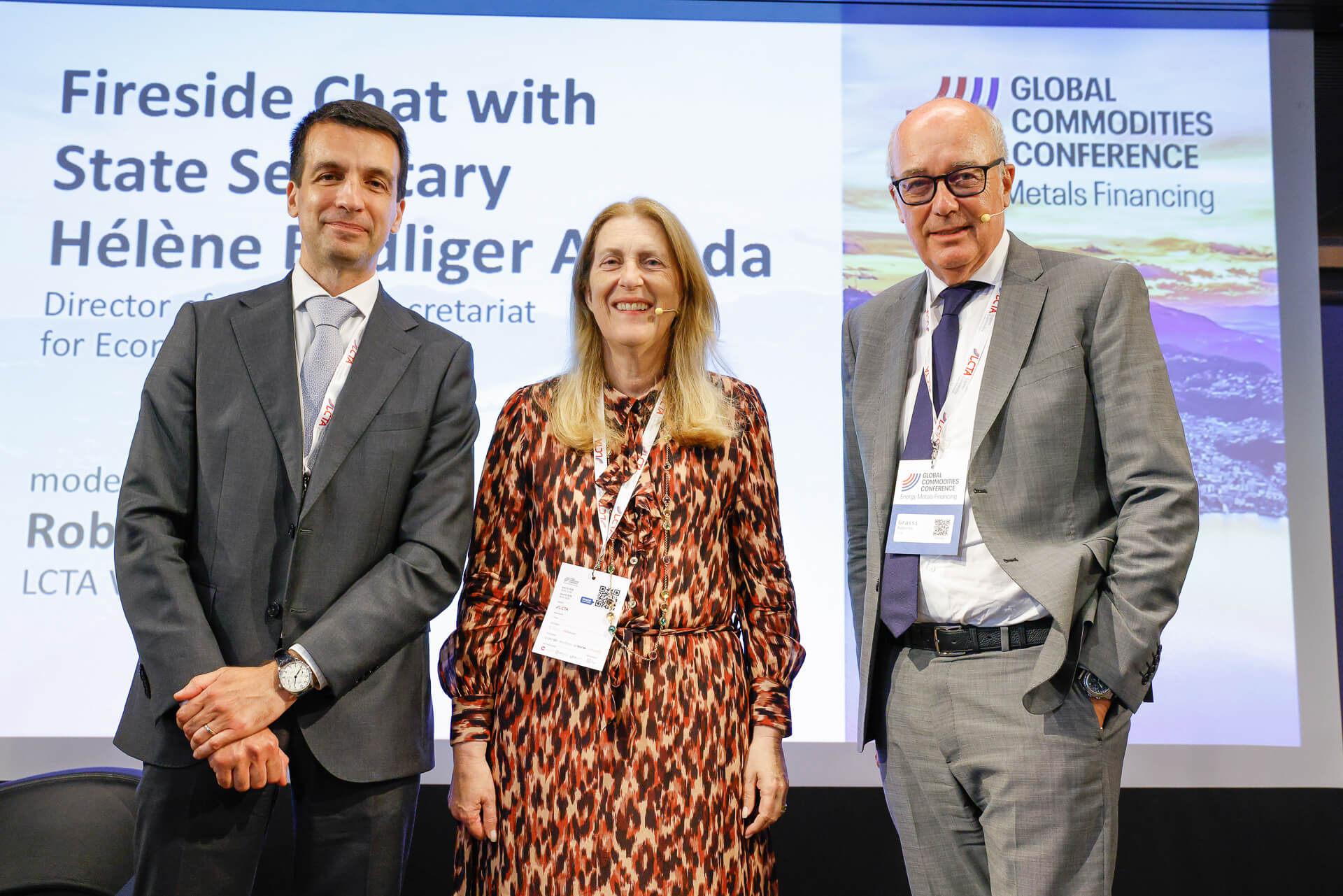
The reconfiguration of commodities flows formed the core of the debate taking place afterwards. Moderated by LCTA Vice President Roberto Grassi, the panel of speakers composed by Laurence Debalme (UBS Switzerland AG), Nikolay Litvinenko (Telf AG), Vincenzo Romeo (Nova Marine Carriers SA), Alberto Salsiccia (Petraco Oil Company SA), observed that global trade behaves like water: it always finds a way around obstacles. The loss of Ukrainian grain exports, for instance, did not halt global grain markets; it redirected supply to alternative producers, albeit at the cost of extended routes, higher freight rates and persistent volatility. For governments and consumers, these disruptions are destabilizing. For traders, however, volatility offers opportunity.

European competitiveness and the burden of unilateral regulation provoked particularly frank discussions. Panelists expressed concerns at the growing regulatory asymmetry between Europe and the rest of the world. Carbon pricing mechanisms, sustainability mandates and sector-specific requirements may reflect Europe’s political ambition, but they impose costs not borne by overseas competitors. These dynamic risks accelerating the deindustrialization of the continent without achieving meaningful reductions in global emissions. Speakers underscored that climate policy must be internationally coordinated to be effective; otherwise, Europe risks “solving” the emissions problem by exporting both production and pollution.

A particularly sharp analysis focused on the midstream segment of commodity supply chains. It is not access to raw materials that determines global leverage, but control over processing capacity. As examples, Cobalt mined in the Congo or copper extracted in Chile can be purchased on the open market, but the real strategic bottleneck lies in refining, smelting and chemical conversion. Unlike certain countries, Europe is missing midstream industrial capacity and this is where investment needs to be deployed. The consequence is clear: geopolitical influence in the commodity sector flows through processing plants, not mine’s shafts. Panelists argued that the next decade of industrial policy should focus less on extracting new resources and more on reclaiming the processing and conversion capabilities that underpin technological industries.

On currency dynamics, there was consensus that discussions around the decline of the US dollar remain largely theoretical. While sanctions and specific bilateral arrangements have led to increased use of alternative currencies such as the yuan or the dirham on certain routes, these shifts are tactical rather than structural. The dollar continues to anchor commodity pricing, financial markets and risk management frameworks. Moreover, a weaker dollar often benefits traders by supporting higher commodity prices, which translate into stronger revenues. The room agreed: there is currently no viable geopolitical or financial alternative to the US dollar.

Technology offered a contrasting picture of dynamism and inertia. Artificial intelligence is advancing rapidly in practical applications such as predictive maintenance for vessels, anomaly detection in risk models and the automation of reconciliation workflows. Yet the broader digitalization of trade remains stalled. Electronic bills of lading represent only a tiny fraction of global shipments. Banks, insurers and customs authorities continue to trust paper documentation because no unified legal and technological standard exists. The commodity sector, despite its scale and sophistication, still relies heavily on analog systems that have changed little in decades.

Beyond the structured agenda, the interpersonal dimension of the roundtable was notable. In front of the 130 attendees representing diverse segments of the commodity ecosystem, the discussions were candid and often personal. Panelists exchanged not only data and forecasts but also maxims, professional lessons and reflections on crisis management. A recurring theme was the importance of relationships. In the words repeated throughout the event, in times of crisis, one must already know the people capable of solving it.

The Lugano roundtable ended with a sober assessment of the world as it is becoming. Commodity markets are entering an era defined by fragmentation rather than integration, by volatility rather than stability, and by processing capacity rather than raw extraction. Switzerland’s role as a neutral, predictable and sophisticated hub appears more valuable than ever. For the companies represented at the roundtable, the challenge is not to rebuild the world of yesterday but to adapt to a new system where geopolitical shifts, regulatory divergence and technological change are the defining economic forces of the decade ahead.


Photogallery


To monitor the evolution of the commodity trading sector and assess its overall economic impact, LCTA conducted a survey among its members in fall 2025, involving exclusively trading companies. Despite the challenges faced in global markets, the detailed overview of sector performance for the period 2021–2023 reveals solid financial fundamentals, dynamic markets, a growing workforce, and employment structures aligned with the operational nature of the industry.

The results of the 2021–2023 survey conducted among member companies of the Lugano Commodity Trading Association (LCTA) confirm the sector’s robustness despite global headwinds. Over 75% of the companies surveyed maintain their headquarters in Ticino, consolidating Lugano’s role as an international trading hub and underscoring the Canton’s strategic importance within the global commodities value chain.

Participant revenues recorded a significant increase in 2022, followed by a contraction in 2023, yet remained above 2021 levels, confirming an overall positive trajectory. Wage expenditure rose over the past two years, reflecting both workforce expansion and corporate performance. Furthermore, a cross verification with Cantonal Authorities shows that the tax contributions of the surveyed companies account for over 70% of the sector’s consolidated tax revenue (federal, cantonal and municipal), attesting to the economic relevance of the member companies.

Employment in the sector continues to expand, with cross-border workers consistently representing around 30% of the total staff. This confirms both its integration within the wider regional labor market and Ticino’s ability to attract skilled local talent. Workforce structures remain predominantly focused on operational and specialist roles, although managerial positions – currently around 25% of the total – are gradually increasing. Projections estimate approximately 1,000 full-time equivalent positions in 2023 within trading companies alone, excluding employees of related service providers.

From an operational standpoint, the energy segment showed diverse trends: oil and fuels grew steadily; LNG experienced a strong rebound in 2023; gas and coal saw declines, likely linked to exogenous factors such as financial and insurance restrictions in European markets affecting coal. Metals also displayed divergent patterns: non-ferrous metals more than doubled in volume in 2022 and stabilized in 2023; ferrous metals declined structurally, partly driven by a reduction in volumes from Russia and Ukraine—historically significant for traders in Ticino. Other commodities showed growth in 2022 and a moderate decline in 2023, confirming the sector’s ability to realign towards higher-yielding or high-potential segments.

Overall, the data depict a mature and resilient sector, solidly anchored in the cantonal economy and capable of withstanding pressures linked to global competition and geopolitical risks. LCTA remains committed to investing in talent development and enhancing the region’s attractiveness, thereby supporting Ticino’s competitiveness on the international stage.

Lugano, December 3, 2025

Contact: Monica Zurfluh, LCTA Secretary General, zurfluh@lcta.ch, M +41 79 220 40 71

LCTA is a non-profit association based in Lugano, founded in 2010. It currently has around fifty members, including some of the major operators in the commodity trading sector and its ecosystem. Ticino is a key global center for the trading of ferrous and non-ferrous metals—particularly gold and steel—as well as coal, coke, natural gas, and electricity

Document


On October 2, 2025, the Chamber of Commerce and Industry of Ticino (Cc-Ti) and the Lugano Commodity Trading Association (LCTA) welcomed a distinguished audience of entrepreneurs, executives, and commodity traders to Villa Principe Leopoldo in Lugano for an exclusive gathering on Saudi Vision 2030, global trade, and risk management. The event, organized in partnership with Allianz Trade and featuring the participation of Saudi Exim Bank, came at a critical moment of unprecedented economic uncertainty — but also of historic opportunity.

Against the elegant backdrop of Villa Principe Leopoldo, overlooking Lake Lugano, the information session brought together practical insights and strategic vision, offering attendees concrete tools to navigate one of the world’s most dynamic emerging markets.

The event opened with Luca Albertoni, CEO of Cc-Ti, who emphasized the Chamber’s mission to help companies in Ticino and beyond “anticipate international trends, identify opportunities, and mitigate risks” when venturing abroad.

Uncertainty and Opportunity in Global Trade

The first keynote came from Anil Berry, Member of the Group Board of Management Commercial, Allianz Trade. He did not mince words: the global economy, he explained, is facing exceptionally high uncertainty. Insolvencies, which only a few years ago were at historic lows, have now surged back to alarming levels – and with unprecedented speed. Whereas companies once collapsed over three or four years, today that can happen in as little as three or four months.

Berry pointed to several structural factors: supply chain bottlenecks are delaying goods by an average of 30 days, while tariff tensions and financing challenges weigh heavily on businesses. Yet, amid the turbulence, opportunities remain.

Global growth for 2026 is projected at 2.5%, with the U.S. expected to lead long-term expansion and the Middle East — particularly Saudi Arabia — emerging as a strategic region for investment. Allianz Trade, he underlined, plays a pivotal role in this landscape, managing €1.3 trillion in risk at any given time and enabling nearly €6 trillion in trade flows annually.

Saudi Arabia’s Vision 2030 and the Role of Saudi Exim

Building on Berry’s global analysis, the spotlight then shifted to a specific opportunity: Saudi Arabia’s economic transformation. Abeer AlHarbi, Credit Underwriting Senior Manager at Saudi Exim Bank, introduced Saudi Eximas a Strategic Initiative for Trade Credit Insurance under ‘Project Bridges. Founded in 2020 to “empower the Saudi non-oil economy in global markets”, the bank has already facilitated more than $24 billion in financing and insurance solutions for exports to over 150 countries.

The numbers tell a compelling story: with 63% of the population under 30 and GDP growing nearly 9% annually since 2016, Saudi Arabia is rapidly positioning itself as a global industrial hub. This demographic dividend, combined with massive infrastructure investments, creates exceptional demand for technology, machinery, and expertise — precisely the areas where Swiss companies excel.

AlHarbi highlighted ‘Project Bridges’ (“Jusoor” in Arabic), a landmark reinsurance collaboration with Allianz Trade.

Far from being a purely defensive tool, the initiative is designed to expand financing capacity for Saudi companies and their global counterparts, easing access for Swiss and European exporters entering the Saudi market. AlHarbi explained that the program plays a direct role in advancing Vision 2030 by:

  • Driving industrial growth – supporting the import of equipment and advanced technologies to boost local productivity.
  • Securing supply chains – guaranteeing reliable flows of raw materials and machinery from more than 70 countries.
  • Unlocking export potential – enabling Saudi manufacturers to reach new international markets with confidence.
  • Encouraging foreign investment – providing robust insurance solutions that reduce entry risks for overseas partners.

Making “Bridges” Work: Practical Guidance

The final presentation was delivered by William Whittington, Regional Head at Allianz Trade. His session peeled back the technical layers of ‘Bridges’ and made them accessible to the audience. He described a process designed to be as seamless as possible: exporters or their banks submit inquiries through Allianz Trade’s usual channels, after which Allianz and Saudi Exim conduct independent credit reviews and ESG/KYC screening. Once approved, clients benefit from non-cancellable limits and expanded insurance capacity – up to $100 million per Saudi buyer, with financing terms extending as long as seven years.

Whittington also shared a concrete case study that resonated with the audience: a commodity trader who, thanks to ‘Bridges’, secured seven times the insurance limit normally available for a Saudi transaction. This dramatic expansion of capacity transformed a cautious test transaction into a strategic partnership. The flexibility, he stressed, is not limited to large corporations — SMEs are equally eligible, with no minimum transaction size required.

A Cautious Optimism – and a Clear Path Forward

The discussions painted a nuanced picture. On one hand, the fragility of the global economy remains evident, with insolvencies rising, financing conditions tightening, and geopolitical crises adding further layers of complexity. On the other, innovative frameworks like the Allianz–Saudi Exim partnership are actively reshaping how companies approach trade in volatile markets.

As the event drew to a close, a sense of cautious optimism prevailed. For Swiss businesses looking outward, Saudi Arabia’s Vision 2030 and the instruments presented – from Allianz Trade’s global risk solutions to Saudi Exim’s financing and insurance tools – represent not just theoretical opportunities, but practical bridges to new markets.

The message was clear: in an era of uncertainty, the companies that will thrive are those that combine bold vision with careful risk management. The tools exist. The market is ready. The question for Ticino’s entrepreneurs is no longer whether to explore Saudi opportunities — but when to begin.


The 2025 edition of the Global Commodities Conference – the flagship event of the Lugano Commodity Trading Association (LCTA) – took place on June 23 and 24 at the iconic LAC Lugano. Over 200 industry leaders and professionals gathered for two dynamic days of insightful discussions exploring the shifting geopolitical landscape and its profound impact on financial markets and commodities trading.

This year’s conference was proudly supported by a distinguished lineup of sponsors: Fidinam Group Holding as Platinum Sponsor; Axion SWISS Bank as Dinner Sponsor; Gold Sponsors Banca Zarattini, Sirius Energy and Telf; and Silver Sponsors Cornèr Banca, Filhet-Allard Maritime and London Metal Exchange. Held under the patronage of the City of Lugano and bolstered by institutional partners including the Ticino Chamber of Commerce and Industry (Cc-Ti), SUISSENÉGOCE, and the Zug Commodity Association, the event was also amplified through a media partnership with Corriere del Ticino.

Certified Commodity Trading Specialist Diploma Ceremony

The conference opened with the diploma ceremony for the second cohort of the Certified Commodity Trading Specialist program, which concluded in January 2025. Fifteen of the seventeen graduates were recognized on stage by LCTA President Matteo Somaini and Cristina Campana of Alma Impact: Zoran Anastasov, Brando Berti, Andrea Crespi Bel’skij, Andrea Brambilla, Gabriella D’Aleo, Ievgeniia Dmukh, Alessio Figliolia, William Kucera, Svitlana Lomatschinsky, Riccardo Maffi, Lorenza Michelini, Stefano Negri, Kaveh Nicjoo, Massimiliano Zanetti, and Ilenia Zendri (absent: Raùl Blanco Cañeque and Meltem Meshur).

Alessio Figliolia received the Best Student Award from Alma Impact’s co-founder and President, Alberto Stival.

Fireside Chat with Sergio Ermotti

A standout moment was the fireside chat with Sergio P. Ermotti, Group CEO of UBS. Mr. Ermotti engaged with LCTA Vice-President Roberto Grassi and the audience on pressing topics including the global economic outlook and the ongoing integration of Credit Suisse, which is progressing well. Outside of Switzerland, the vast majority of clients have already transferred and, by the end of first quarter of 2026, clients in Switzerland will also have migrated.

Mr. Ermotti noted the remarkable resilience of financial markets despite geopolitical shocks, saying markets were surprisingly calm given recent events. Addressing the alleged dollar crisis, he emphasized the absence of viable alternatives due to structural and political constraints in other major currencies and capital markets.

On trade, Mr. Ermotti expressed cautious optimism about future agreements between the U.S., Europe (including Switzerland), and other regions, predicting a shift toward regionalism rather than a full-scale deglobalization, which he emphasized would lead to a severe contraction of global economies. He also reaffirmed UBS’s stance on the Federal Council’s proposed updates to the “too big to fail” banking regulations, cautioning that increased capital requirements raise costs and constrain lending, and underscoring that trust remains the core capital of banking.

Geopolitical Complexity and Industry Resilience

LCTA President Matteo Somaini welcomed attendees to the second day of the Global Commodity Conference 2025, acknowledging the need for trading companies to adapt their business model to the protectionism, to the uncertainty and to a fragmented global landscape while key partners, like banks, are facing their challenges and adjust at different paces.

He welcomed the diverse group of experts and emphasized the growing strategic relevance of Middle Eastern economies. He also pointed to Europe’s limited relevance in current global discussions. Finally, he acknowledged the recent geopolitical upheavals, emphasizing the unforeseen importance of these discussions today.

China and the Global Economy

In a compelling keynote, Professor Keyu Jin (HKUST Business School and Harvard) explored China’s shifting position in the global economy. Amid ongoing trade fragmentation and U.S.-China tensions, she described China as pursuing a strategy of recalibration—enhancing its self-reliance while remaining selectively open to global markets.

Jin noted that while China continues to protect its economic framework and political independence, it is also gradually opening sectors such as finance and services to private initiatives. Domestically, she acknowledged significant structural challenges, including a struggling real estate sector, low consumption, and regional disparities, but highlighted the dynamism of the younger, globally engaged generation as a potential catalyst for change.

Regarding technology, Jin observed that external restrictions—such as U.S. export controls—have spurred a stronger national focus on innovation, with China now aiming for leadership in emerging industries.

Her message underscored that China’s path is one of measured transformation, designed to manage disruptions, redefine trade patterns, and advance its technological development.

Geopolitical Shockwaves and Strategic Uncertainty: A World on the Edge

In her keynote, Emily Harding (Center for Strategic and International Studies, CSIS) reflected on recent geopolitical disruptions—including events in Iran and shifting global alliances—as signs of a broader shift in the international order.

She described how key powers like Russia, China, and the U.S. are increasingly shaping global dynamics through forceful, transactional approaches. U.S. policy under Trump, she noted, is marked by strategic decoupling from China in critical sectors, driven by efforts to bolster national resilience and reduce dependency. This approach is part of a broader populist doctrine that emphasizes economic sovereignty, challenges multilateral frameworks, and relies on strong domestic appeal.

Harding also addressed the internal pressures facing the U.S.—from inflation and inequality to institutional mistrust—alongside the accelerating impact of technologies like AI and biotechnology.

She concluded on a cautiously optimistic note, suggesting that while political volatility remains, technological innovation and a desire for stability among business leaders could help steer the system forward—if governance can keep pace.

The Certainty of Uncertainty: the Turbulent Future of Global Politics and Economics

In his keynote, economist and author Alan Friedman described the current geopolitical and economic climate as marked by persistent uncertainty, fueled by unpredictable leadership, volatile policies, and the global rise of populism.

He characterized President Trump’s approach to foreign and economic policy as protectionist and erratic, raising concerns about the impact of trade tariffs on global stability. In contrast, he noted China’s more deliberate, long-term strategy, particularly in its handling of international relations and economic planning.

Friedman pointed to increasing fragmentation in global politics, including closer ties among authoritarian regimes and growing political unrest in the U.S. He warned of the risks of deglobalization, shifting trade dynamics, and questions over the long-term strength of the U.S. dollar, while suggesting that Europe could emerge as a more attractive investment destination.

Closing his remarks, Friedman drew historical parallels with the interwar period, cautioning that today’s wave of populism and polarization could pose serious challenges to democratic institutions and global stability. He urged continued vigilance in navigating an increasingly unpredictable world.

Experts’ Roundtable: Energy, U.S.-China Rivalry, and AI

Moderated by James May (DITH), the panel discussion brought together Emily Harding (CSIS), Alan Friedman, Mattia Giussani (Sirius Energy), and Nikolai Litvinenko (Telf) tackled the pressing issues shaping today’s geopolitical and economic landscape.

The discussion began with Europe’s efforts to enhance energy independence in response to global disruptions, with panelists emphasizing the role of renewables and innovation in ensuring long-term energy security.

Attention then turned to the strategic competition between the U.S. and China, particularly in the context of manufacturing and control over renewable energy supply chains. While the challenges are considerable, the panel agreed that targeted investment and policy reform could help the U.S. strengthen its position.

Artificial intelligence featured prominently, with debate on its disruptive potential in sectors like energy and finance, the need for stronger cybersecurity, and concerns about its misuse in conflict scenarios. The session concluded with a shared call for greater international cooperation and diplomatic engagement as essential means to navigate uncertainty and support global stability.


Catch the highlights through our video and full photo coverage


As of June 4, 2025, the United States has raised the additional tariffs on steel, aluminum, and related imports from 25% to 50%. This higher rate applies to all goods entered into U.S. customs or removed from bonded storage for domestic use.

This measure was officially enacted through the Presidential Proclamation of June 3. The specific tariff classifications affected are detailed in the List of Aluminum HTS subject to Section 232 and the List of Steel HTS subject to Section 232.

Exceptions and special tariffs

Steel, aluminum and derivative products originating from the United Kingdom retain a reduced tariff rate of 25% until July 9, 2025.

Products containing primary aluminum melted or cast in Russia—or imported directly from Russia—are subject to a 200% duty on the total value (in practice, the trade of such products by Swiss and European companies is made impossible by current sanctions, particularly those under the 16th sanctions package).

Partial basis calculation

From June 4, 2025, the 50% tariff applies only to the portion of the product made of aluminum or steel. The remaining part is subject to any applicable reciprocal duties (set at 10% until July 9, after which country-specific reciprocal rates will take effect).

Declaration requirements

Importers are required to report the ISO country codes for the following stages of aluminum processing:

  • primarily melting (first smelting),
  • secondarily melting (from recycled material),
  • casting (transformation into solid form).

As of June 28, 2025, if the country of smelting and casting is unknown, the code “UN” must be used. This will lead to classification under HTS codes 9903.85.67 or 9903.85.68 and the imposition of a 200% tariff, the same rate applied to aluminum originating from Russia.

For steel and derivative products, importers must provide both the ISO code for the melting and casting country and an “applicability code” as follows:

  • for steel products: specify the country of original melting and casting
  • for derivatives: report the country where the steel was melted, or enter “OTH” (other) if the origin is unknown.

Other provisions

Tariffs imposed under Section 232 are not eligible for drawback, meaning no refunds will be issued.

The 50% tariff applies in addition to any other applicable customs duties (e.g., anti-dumping duties), but does not stack with reciprocal tariffs.

To avoid overlaps, the rules for cumulative tariff application have been revised. The updated order of precedence for applying different tariff types is as follows:

  • motor vehicles and components: 25%
  • steel and aluminum: 50%
  • IEEPA tariffs on goods from Canada and Mexico: generally 25%, or 10% for certain products

This new priority order means that metals from Canada and Mexico are now fully subject to the 50% Section 232 tariff without any reduction.

To support accurate tariff classification, U.S. Customs and Border Protection (CBP) has issued the following guidance:

The CSMS #65236574 notice provides clarifications on the cumulative application of tariffs and the correct order of their imposition.

Additional useful documents:


As part of the proposed budget relief measures for 2027, the federal government is considering reducing its financial support for regional aerodromes.

LCTA joins ASPASI (the Association of Passengers and Airports of Southern Switzerland (ASPASI), the Ticino Chamber of Commerce and Industry (Cc-Ti), the Ticino Banking Association (ABT), and other economic and tourism associations in Ticino in voicing concern over the potential consequences of cutting the approximately 5 million Swiss francs in annual funding currently allocated to Lugano-Agno Airport.
As the only airport located south of the Alps, Lugano Airport holds strategic importance at the national level and deserves full recognition. Its strong emphasis on business travel also makes it a vital asset for the competitiveness of the Ticino economic region.

ASPASI Press Release, in Italian (April 16, 2025)


Steel, aluminum, and their derivatives will be subject to an additional 25% duty upon importation into the United States beginning March 12, 2025. The regulation, formalized by two notices from the US customs agency, marks a further tightening of the Country’s trade policy.

In February, President Trump enacted two proclamations – Adjusting Imports of Aluminum into the United States (#10895) e Adjusting Imports of Steel into the United States (#10896) – which bolster the tariffs established under Section 232 of the Trade Expansion Act. The measure not only affirms the 25% duty on steel imports but also escalates the aluminum tariff from 10% to 25% and extends to derivative products effective from March 12, 2025.

The measure’s extension impact multiple product categories:

  • aluminum and derivatives: items classified under tariff chapters 66, 76, 83, 84, 85, 87, 88, 90, 94, 95, and 96.
  • steel and derivatives: items classified under tariff chapters 72, 73, 84, 85, 87, and 94

The measures eliminate all types of preferential treatment, encompassing absolute quotas, tariff quotas, and exemptions for specific countries. Additionally, they terminate previously approved general exclusions (General Approved Exclusions, GEA), retaining only those specific exclusions recorded in the Automated Commercial Environment (ACE) system, which remain valid until their expiration or until the authorized volume is depleted.

Only products manufactured from molten steel or extruded aluminum within the United States will be exempt from the heightened duties. The duty for any other derivatives will be determined based on the value of the base metal.

No duty drawback will be available for these imposed duties. Moreover, steel, aluminum, and their derivatives entering US free zones from March 12, 2025, will obtain “privileged foreign” status and will be subject to duties when entered into the U.S. for consumption.

The U.S. Customs and Border Protection (CBP) has produced two operational documents to elucidate the implementation of the new measures:

The two documents list the subheadings of chapter 99 of the Harmonized Tariff Schedule of the United States (HTSUS) required for import declaration and offer comprehensive guidelines for accurately declaring aluminum and steel content, including the country of “melt and pour” (for aluminum: this also applies when recycled materials are utilized).

Comparison of tariff subheadings

Which tariff subheadings in chapter 99 correspond to the different steel and aluminum items? Refer to our summary table!


The European Commission proposes to streamline the rules on sustainability by changing the scope and timing of the adoption of the CSRD, CSDDD, CBAM and EU Taxonomy.

On February 26, 2025 the European Commission adopted the Omnibus package, a new package of proposals aimed at simplifying EU regulations, enhancing competitiveness, and facilitating increased investment capacity. The legislation encompassed in the package includes the Corporate Sustainability Reporting Directive (CSRD), the Corporate Sustainability Due Diligence Directive (CSDDD), the Carbon Border Adjustment Mechanism (CBAM) and the EU Taxonomy Regulation.

The following is a succinct overview of the suggested changes, without claiming to be exhaustive:

CSRD

  • limitation of reporting companies’ scope to those with >1’000 employees;
  • “value chain cap”: a voluntary reporting standard will be implemented for companies outside the CSRD scope, restricting the information that in-scope companies or banks can solicit from companies in their value chains with <1’000 employees;
  • postponement of reporting obligations by two years for large companies and listed SMEs (so-called Wave 2 and 3);
  • revision of the European Sustainability Reporting standards (“ESRS”) to reduce data points, clarify unclear provisions and enhance alignment with other regulations;
  • deletion of sector-specific standards requirement;
  • removal of the reasonable assurance standard.

CSDDD

  • postponement of the transposition deadline and the application date for the first wave of companies by one year, now set for July 27 and July 2028 respectively, while the adoption of the necessary guidelines has been advanced to July 2026;
  • exemption from the requirement to systematically conduct thorough assessments of adverse impacts in complex value chains; full due diligence is required only when plausible information suggests such impacts;
  • further simplification of sustainability due diligence requirements, including an extension to 5 years for the intervals between periodic assessments and updates, streamlining of stakeholder engagement obligations, and the removal of the requirement to terminate business relationships as a last resort measure;
  • restriction on the information that in-scope companies may solicit from their SME and small midcap business partners (i.e. companies <500 employees) to that specified in the CSRD voluntary sustainability reporting standards (VSME standard); additional information may only be requested if essential for conducting the mapping and cannot be acquired through other reasonable methods;
  • deletion of the obligation to terminate as a last resort: companies would only be required to halt engagements pertaining to the relevant activity.

CBAM

  • exemption from CBAM obligations for small importers (<50 tons per year);
  • simplification of declarants’ authorization, embedded emissions’ calculation, reporting requirements and compliance with financial liabilities for CBAM in-scope importers.

The Commission confirms its intention to broaden the scope of CBAM to encompass other sectors within the existing emissions trading scheme and downstream products, with a legislative proposal expected by 2026.

Taxonomy

  • voluntary Taxonomy reporting for CSRD in-scope companies (>1’000 employees) with a net turnover of up to EUR 450 million;
  • simplification of reporting templates;
  • simplifications of Taxonomy-based KPIs for banks by excluding exposures from the Green Asset Ratio (GAR) for companies not included in the future scope of the CSRD.

Useful links


The EU Forced Labour Regulation entered into force on December 13, 2024. It will take effect on December 14, 2027 prohibiting the placement and availability of goods produced by forced labour on and from the EU market.

The Regulation (EU) 2024/3015 on prohibiting products made with forced labour on the Union market (Forced Labour Regulation, FLR), aligns the definition of “forced labour” (or “compulsory labour”) with the International Labour Organization Convention No. 29 (Forced Labour Convention). It encompasses all work or service “which is exacted from any person under the menace of any penalty and for which the said person has not offered himself voluntarily”, or used as a method of coercion, punishment, discipline, or discrimination.

The FLR applies to all goods sold in or exported from the European Union, regardless of geographic origin or industry and without value thresholds: effective December 14, 2027, products and their components will be banned from the market if forced labour is employed at any stage of their production, manufacture, harvesting, or extraction, in whole or in part, including any work or processing associated with the product at any of these stages.

The Regulation does not introduce additional human rights due diligence obligations on businesses, but strengthens the Member States’ legislation on forced labour and the EU frameworks, including the EU Corporate Sustainability Due Diligence Directive (CSDDD). While the CSDDD establishes due diligence obligations regarding forced labour impacts for businesses across the value chain but does not include provisions to ban the importation of products into the EU market, the FLR implements mechanisms for the ban, withdrawal or disposal of goods made with forced labour, requiring products to be recycled, rendered inoperable, or destroyed.

By December 14, 2025, Member States are required to appoint a competent authority and notify the European Commission, which will publish the authorities’ list in the so-called “Forced Labour Single Portal”. The portal, to be established by June 14, 2026, will also serve as a repository for decisions and guidelines for businesses, including due diligence procedures and best practices for termination and remediation of different types of forced labour. The European Commission is also required to establish a public database detailing forced labour risks in specific geographic areas, products or product categories, including forced labour imposed by state authorities. Decisions regarding the prohibition, withdrawal, or disposal of products will be acknowledged throughout the Member States. Businesses failing to comply with a decision under the Regulation may incur in fines.

Recommendations

Businesses have three years to assess the existence of forced labour risks within their supply chains, whether directly through their import or export activities or indirectly via reliance on imported or exported products, and to map their potential exposure. Concurrently, they should also ensure the inclusion of appropriate clauses in contracts with their suppliers to mitigate the risk of certain products being held at the EU border, resulting in market withdrawal or disposal.


Dear Members and extended Community,

as we bid farewell to 2024 and embrace new beginnings, we would like to take a moment to express our heartfelt gratitude for the trust and cooperation you have shown us. To be more specific, dear Members, your support has been vital to our journey, and we are extremely grateful to have you by our side.

The year has been once again a difficult one, with commodity traders facing daily challenges that have been further exacerbated by an increasing political interference in market activities. Fortunately, the sector has proven time and time again that it has what it takes to overcome these obstacles, but in an ever-changing environment, knowledge, training, experience sharing, and a competitive and attractive business location are cornerstones. Thus, in 2025 the LCTA will continue its efforts to offer valuable training and networking opportunities while also maintaining an open line of communication with authorities and other significant stakeholders.

During our discussions with such key players, we regrettably noticed that the sector’s significance is frequently undervalued. To address the shortage of accurate baseline statistic data and gain stronger bargaining power, the LCTA will therefore launch a substantial Industry Assessment and Data Collection survey. To safeguard your privacy, we will use state-of-the-art cryptography. We will delve deeper into this matter in the coming months, but for the time being, just know how important your input is: help us serve you!

In the meantime, we wish you and your loved ones a joyful holiday season and a New Year filled with opportunities, renewed partnerships, and continued growth.

Warmest regards,

Matteo Somaini, President & Monica Zurfluh, Secretary General

News & Agenda

Newsletter

Do you have a question?
Get in touch.

© LCTA – made by studio daulte

News & Agenda

Newsletter

Do you have a question?
Get in touch.

© LCTA – made by studio daulte