

To monitor the evolution of the commodity trading sector and assess its overall economic impact, LCTA conducted a survey among its members in fall 2025, involving exclusively trading companies. Despite the challenges faced in global markets, the detailed overview of sector performance for the period 2021–2023 reveals solid financial fundamentals, dynamic markets, a growing workforce, and employment structures aligned with the operational nature of the industry.

The results of the 2021–2023 survey conducted among member companies of the Lugano Commodity Trading Association (LCTA) confirm the sector’s robustness despite global headwinds. Over 75% of the companies surveyed maintain their headquarters in Ticino, consolidating Lugano’s role as an international trading hub and underscoring the Canton’s strategic importance within the global commodities value chain.

Participant revenues recorded a significant increase in 2022, followed by a contraction in 2023, yet remained above 2021 levels, confirming an overall positive trajectory. Wage expenditure rose over the past two years, reflecting both workforce expansion and corporate performance. Furthermore, a cross verification with Cantonal Authorities shows that the tax contributions of the surveyed companies account for over 70% of the sector’s consolidated tax revenue (federal, cantonal and municipal), attesting to the economic relevance of the member companies.

Employment in the sector continues to expand, with cross-border workers consistently representing around 30% of the total staff. This confirms both its integration within the wider regional labor market and Ticino’s ability to attract skilled local talent. Workforce structures remain predominantly focused on operational and specialist roles, although managerial positions – currently around 25% of the total – are gradually increasing. Projections estimate approximately 1,000 full-time equivalent positions in 2023 within trading companies alone, excluding employees of related service providers.

From an operational standpoint, the energy segment showed diverse trends: oil and fuels grew steadily; LNG experienced a strong rebound in 2023; gas and coal saw declines, likely linked to exogenous factors such as financial and insurance restrictions in European markets affecting coal. Metals also displayed divergent patterns: non-ferrous metals more than doubled in volume in 2022 and stabilized in 2023; ferrous metals declined structurally, partly driven by a reduction in volumes from Russia and Ukraine—historically significant for traders in Ticino. Other commodities showed growth in 2022 and a moderate decline in 2023, confirming the sector’s ability to realign towards higher-yielding or high-potential segments.

Overall, the data depict a mature and resilient sector, solidly anchored in the cantonal economy and capable of withstanding pressures linked to global competition and geopolitical risks. LCTA remains committed to investing in talent development and enhancing the region’s attractiveness, thereby supporting Ticino’s competitiveness on the international stage.

Lugano, December 3, 2025

Contact: Monica Zurfluh, LCTA Secretary General, zurfluh@lcta.ch, M +41 79 220 40 71

LCTA is a non-profit association based in Lugano, founded in 2010. It currently has around fifty members, including some of the major operators in the commodity trading sector and its ecosystem. Ticino is a key global center for the trading of ferrous and non-ferrous metals—particularly gold and steel—as well as coal, coke, natural gas, and electricity

Document


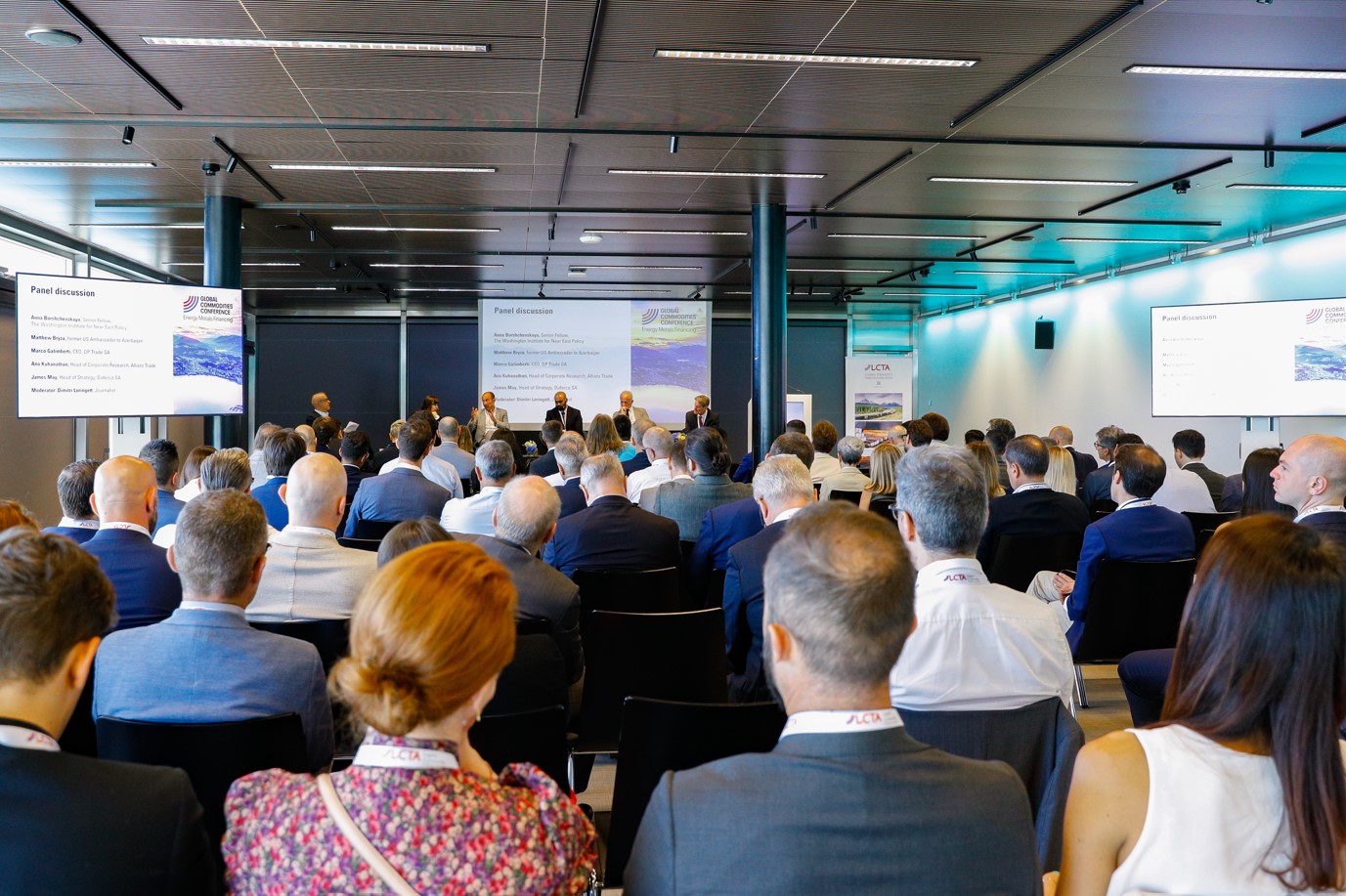
The “Global Commodities Conference”, the Lugano Commodity Trading Association’s (LCTA) flagship event, has returned to Lugano two years after its previous edition. In fact, the commodities world gathered on July 1 and 2, 2024 to examine and analyze the new geopolitical dynamics and the energy transition, as well as their impact on global commodity markets.

Global geopolitics and trade patterns are rapidly changing. Tensions in the Middle East, in particular, are putting a strain on key commodities, affecting trade routes and supply chains. For its part, the “green transition” is generating major problems about sustainable sourcing and commitment to ethical commodity manufacturing, as well as increasing demand for clean energy-related raw materials. The Global Commodities Conference 2024, organized by the Lugano Commodity Trading Association (LCTA), provided an opportunity for Swiss and international commodity traders, as well as banks and insurance companies active in the sector, to participate in a meaningful discussion on these issues and confirm how commodity trading can cope with global fragmentation and a new world order by navigating operational complexity, making necessary adjustments and capitalizing on new trading opportunities.

The 2024 Conference kicked off on July 1 with an inaugural dinner at SEVEN Restaurant in Lugano. Following introductory remarks by LCTA Vice President Roberto Grassi, Yves Rossier, former Swiss Ambassador to Russia, delivered a caustic and stinging address on a monobloc world, the cause-and-effect links between war, trade and sanctions, and Switzerland’s increasingly irrelevant role in the global diplomatic theater.

The Conference continued the next day at LAC Lugano Art and Culture, with President Matteo Somaini delivering the opening remarks followed by two sessions.

In the first session, Matthew Bryza, former U.S. ambassador to Azerbaijan, discussed the new Middle East chessboard and the different chess pieces. Following his remarks, foreign policy scholar Anna Borshchevskaya, Senior Member of The Washington Institute for Near East Policy, Marco Galimberti, CEO of DP Trade SA, Ano Kuhanathan, Head of Corporate Research at Allianz Trade and James May, Head of Strategy at Duferco SA, and Matthew Bryza himself participated in a panel moderated by Corriere del Ticino journalist Dimitri Loringett. The panel of analysts and industry leaders examined the effects of the conflict on commodity trade and shipping, from logistical aspects to rising costs and risk management, highlighting how the negative effects of uncertainty have spilled over to Europe and in particular its “locomotive” (Germany), which is becoming less competitive, but not forgetting the opportunities presented by the Middle East, which is now a key player in the energy transition.

The second session was led by Deia Markova, Head of Trade Commodity Finance at Société Générale Corporate & Investment Banking (SGCIB), who discussed the “greening” of commodities and the “decommoditization” of the sector, as a result of the energy transition, as well as how commodity producers and traders can adapt to this shifting environment. Simone Knobloch, COO of Valcambi SA; Giulio Macciocchi, Head of Finance & ESG at DXT Commodities SA; Stephen Thomas, Head of ESG & Sustainability at ArrowResources AG; and Deia Markova herself discussed the topic in a panel moderated by Dominique Bruggmann, Manager Financial Services Risk Consulting at Ernst & Young AG. The panelists emphasized the role of carbon markets in the transition to decarbonization as well as the fact that customers and financial institutions are increasingly demanding commodities from sustainable and responsible sources, they also acknowledged the risk of overregulation and the need to find solutions that work for everyone.

The closing remarks were given by LCTA President Matteo Somaini, who shared his “takeaways”, including: the relativity of concepts such as multipolarity, volatility and stability; the possible emergence of a new paradigm in which politics predominates over economics; the need for traders to capitalize on transitions, particularly the energy transition, and how the latter goes hand in hand with a “resource-less transition”, which requires the implementation of new market approach strategies.

It was an intense and thought-provoking Conference with networking opportunities that brought together over 150 industry professionals in Lugano from across Switzerland as well as major centers such as London and Dubai.

Retrospective Global Commodities Conference 2024: a summary of the topics covered and a selection of photos can be found on our website on the dedicated page.

News & Agenda

Newsletter

Do you have a question?
Get in touch.

© LCTA – made by studio daulte

News & Agenda

Newsletter

Do you have a question?
Get in touch.

© LCTA – made by studio daulte