GCC 2026 Retrospective | Trading Through Transformation: Commodity Markets in a Changing World
As the flagship annual event of the Lugano Commodity Trading Association (LCTA), the Global Commodities Conference (GCC) has established itself as a leading forum for dialogue on the forces shaping international commodity markets. Held at LAC Lugano Arte e Cultura on June 22–23, 2026, GCC 2026 brought together over 200 senior representatives from government, diplomacy, academia and industry to examine how geopolitical, technological and financial developments are reshaping the commodity trading landscape.
GCC 2026 was made possible through the valued support of its sponsors and partners. Fidinam Group Holding SA and Banca Zarattini & Co. joined the conference as Gold Sponsors, alongside Cornèr Banca SA, Sirius Energy SA, TELF AG and Valcambi SA as Silver Sponsors, while Axion SWISS Bank supported the opening evening as Dinner Sponsor. Held under the patronage of the City of Lugano, the conference also benefited from the support of its institutional partners—the Ticino Chamber of Commerce and Industry (Cc-Ti), SUISSENÉGOCE and the Zug Commodity Association (ZCA).
This retrospective revisits the key themes that emerged throughout GCC 2026.
One message emerged consistently: commodity trading has entered a new era.
Geopolitical tensions, supply chain disruptions, sanctions, technological competition and monetary uncertainty are often viewed as separate developments. The discussions at GCC 2026 suggested a different interpretation. Together, they point to a broader transformation of the international economic order—one in which geopolitics, finance, technology and industrial policy are becoming increasingly interconnected.
Globalization is not disappearing. International trade continues to connect economies, businesses and societies across the world. What is changing is the framework within which global trade operates. Alongside efficiency, resilience, economic security, trusted partnerships and strategic adaptability define today’s international business environment.
Following chapters revisit the conference through this lens, tracing the discussions from Switzerland’s position in a changing world to the geopolitical transformation of commodity markets and the evolving financial architecture that supports global trade.
Laying the Foundations
GCC 2026 opened with two complementary reflections on the future of commodity trading. The first celebrated the next generation of industry professionals through the CCTS Graduation Ceremony, while the second explored Switzerland’s role as a trusted international trading hub. Together, they established the foundations for the discussions that followed during the main conference day.
Investing in the Future
GCC 2026 opened by celebrating the latest graduates of the Certified Commodity Trading Specialist (CCTS) program, reaffirming LCTA’s long-standing commitment to education and professional development.
The graduating class included Mattia Baratti, Giacomo Cagliani, Giacomo Cazzaniga, Emma Fogagnolo, Stefan Jovanovic, Irina Lyashenko, Marko Markovic and Talia Noémie Odjou. The ceremony also recognized Marko Markovic as the Best Student of the 2025 CCTS edition. Although unable to attend the ceremony in person, his outstanding academic achievement was acknowledged during the evening.
More than a graduation ceremony, the event reaffirmed LCTA’s conviction that the long-term competitiveness of the commodity trading industry ultimately depends on people. As markets become increasingly interconnected and business environments more complex, professional expertise, interdisciplinary knowledge and continuous learning are becoming strategic assets in their own right.
Over the years, the CCTS program has become LCTA’s flagship educational initiative. Delivered in partnership with ALMA Impact, it equips professionals with the interdisciplinary knowledge and practical skills required to navigate today’s increasingly complex commodity trading environment.
Beginning GCC 2026 with the graduation ceremony therefore carried a clear message: before discussing the future of global commodity markets, the conference recognized those who will help shape it.
Switzerland in a Changing World
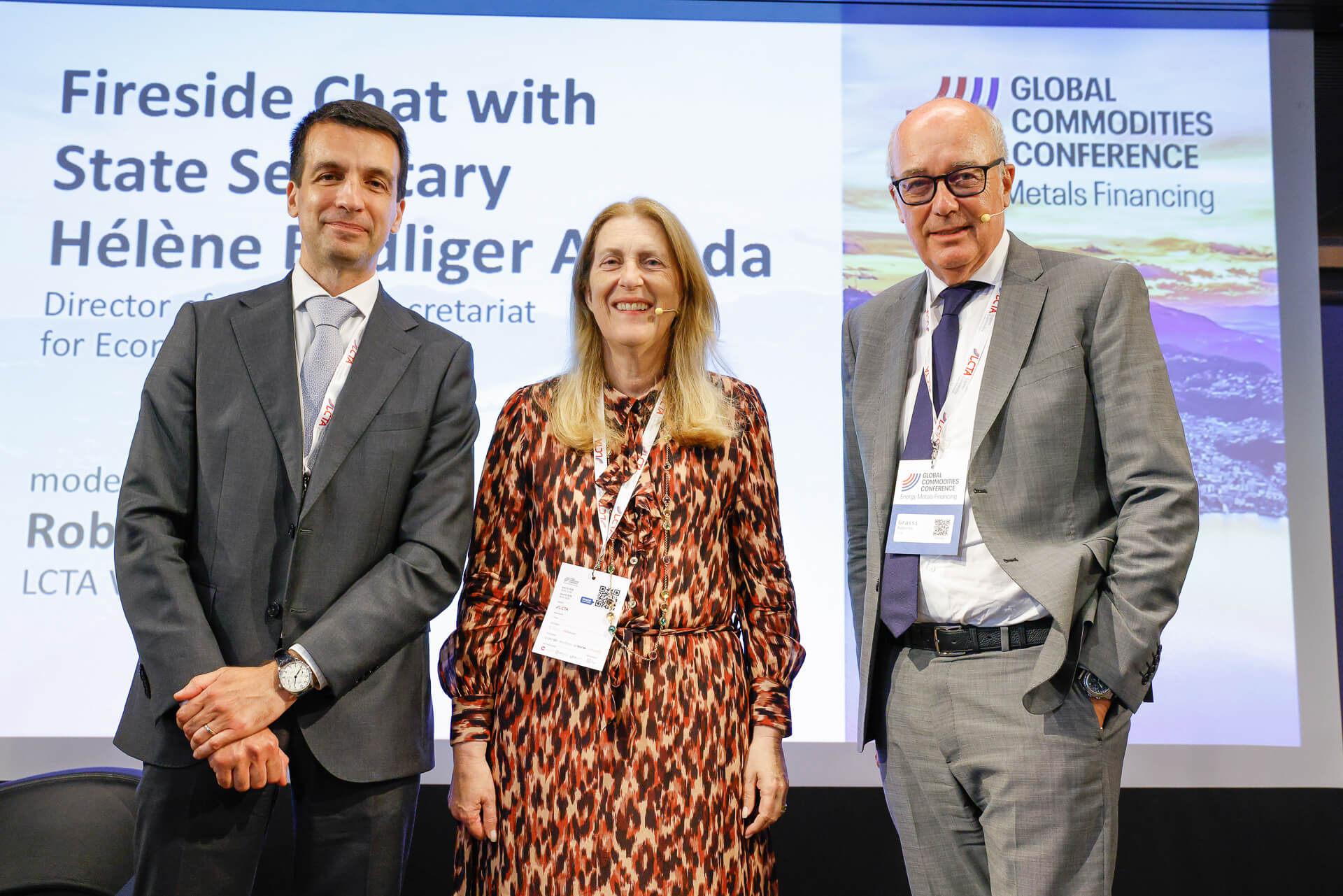
The opening evening continued with a fireside conversation between State Secretary Hélène Budliger Artieda and Roberto Grassi, Vice President of LCTA, examining Switzerland’s position in an international environment increasingly shaped by geopolitical tensions, economic security and strategic competition.
The conversation highlighted that Switzerland’s competitiveness rests on a combination of political stability, legal certainty, institutional reliability and openness to international trade. In a period marked by geopolitical uncertainty and rapidly changing business conditions, these strengths have become even more valuable—but they cannot be taken for granted. Preserving Switzerland’s attractiveness requires continued investment in innovation, talent and sound economic policy, together with an ongoing commitment to international engagement.
Neutrality emerged as one of the defining themes of the discussion. Rather than representing isolation, it was presented as a framework that enables Switzerland to maintain dialogue with a broad range of international partners while upholding its credibility, respecting the rule of law and ensuring the consistent implementation of international obligations, including sanctions.
For the commodity trading industry, these characteristics carry particular significance. Companies operating across multiple jurisdictions depend on stable institutions, transparent regulation and a trusted legal framework from which to manage increasingly complex international operations. In this context, predictability has become a genuine competitive advantage.
By opening GCC 2026 with this conversation, LCTA placed Switzerland’s role within the broader transformation of global trade before turning to the geopolitical and financial forces explored during the main conference day. The discussion served as a reminder that, in an increasingly uncertain world, trust remains one of Switzerland’s most valuable strategic assets.
From Global Challenges to Business Decisions
The main conference day opened with welcome remarks by Matteo Somaini, President of LCTA, and Michele Foletti, Mayor of Lugano.
While Somaini emphasized the value of dialogue between institutions, academia and industry in navigating an increasingly complex global environment, where Geography is no longer based on physical proximity and market players act as nodes of a complex network, questioning the traditional concept of “Region”, Foletti reaffirmed the City’s support for the commodity trading sector and Lugano’s position as one of Europe’s leading trading hubs.
Building on the themes introduced during the opening evening, the conference broadened its focus from Switzerland’s role in the global trading system to the wider geopolitical and financial transformations reshaping commodity markets.
Against this backdrop, the conference turned to its first thematic session: the Geopolitics of Resources.
The Geopolitics of Resources
The first thematic session of GCC 2026 brought together Ambassador Ettore Francesco Sequi, former Secretary General of the Italian Ministry of Foreign Affairs and International Cooperation, with panelists Alessandro Fossati (Gamma Trade SA), Alberto Salsiccia (Petraco Oil Company SA), Professor Fabrizio Vismara (University of Insubria) and Mickael Butikofer (Trafigura). Moderated by Dmitry Dvoretskiy (DITH). The session examined how a rapidly evolving geopolitical landscape is impacting commodity markets and affects business models.
A central message emerged from the discussions: today’s geopolitical tensions should not be viewed as a series of isolated crises. Rather, they are manifestations of a broader transformation of the international order. Strategic competition, economic security and industrial policy are increasingly influencing decisions that were once driven primarily by market forces.
Energy, industrial metals, agricultural products and critical minerals are no longer regarded solely as tradable goods driven by supply and demand. They have become strategic assets that influence industrial competitiveness, technological leadership and national resilience. As a result, commodity markets now sit at the intersection of economics, foreign policy and security.
Strategic advantage today extends far beyond access to natural resources. Increasingly, competitiveness depends on the ability to refine, transport, finance and integrate those resources into resilient industrial ecosystems. Processing capacity, logistics infrastructure, maritime routes and trusted supply chains have therefore become as strategically important as the resources themselves.
This evolution is particularly evident in the technologies driving the global economy. Artificial intelligence, digital infrastructure and the energy transition all rely on secure supplies of electricity, critical minerals, advanced manufacturing and reliable transportation networks. Rather than reducing the importance of physical commodities, technological innovation is reinforcing their strategic value.
For commodity trading companies, these developments have practical consequences. Commercial decisions can no longer be based exclusively on price, supply and demand. They increasingly require an understanding of geopolitical developments, sanctions, regulatory change, infrastructure constraints and evolving trade relationships.
The panel discussion complemented the keynote by translating these geopolitical dynamics into the operational realities faced by commodity trading companies. The exchange reinforced the importance of resilience, diversification and long-term strategic thinking in an increasingly complex business environment.
The panel agreed that this changing environment does not signal the end of globalization. Rather, it reflects a new phase in which resilience complements efficiency, diversification strengthens supply chains and trusted partnerships become increasingly important. International trade remains global, but the conditions under which it operates are becoming more complex.
The session concluded with a clear takeaway: commodity trading is no longer shaped solely by markets. It is increasingly influenced by the interaction between geopolitics, technology, finance and regulation. Understanding these dynamics is no longer simply a competitive advantage—it has become an essential component of doing business in today’s global economy.
Monetary Fragmentation
The second thematic session of GCC 2026 turned from the geopolitics of resources to the financial systems that support international trade. Led by Professor Angelo Ranaldo, with a panel discussion featuring François Broussard (ING), Giulio Macciocchi (DXT Commodities SA) and Fabio Baglio (Tether), and moderated by Dimitri Loringett (Corriere del Ticino), the session explored how geopolitical change is influencing currencies, financial markets and cross-border transactions.
Finance can no longer be separated from geopolitics.
As governments increasingly rely on sanctions, industrial policy and economic security measures, financial markets are adapting to a more fragmented international environment. While the global monetary system has proven remarkably resilient, the context in which it operates is becoming increasingly complex.
The session highlighted that foreign exchange risk is no longer limited to currency fluctuations. Liquidity, funding conditions, payment infrastructure, currency weaponization and regulatory developments have become equally important considerations for companies operating across multiple jurisdictions. For commodity traders, effective financial risk management now extends well beyond exchange rates.
Innovation also featured prominently in the discussion. Digital assets, stablecoins and new payment technologies are creating opportunities to improve the efficiency of cross-border transactions while prompting new discussions around regulation, market confidence and financial stability. Rather than replacing traditional finance, these innovations are evolving alongside established banking systems, expanding the range of tools available to international businesses.
The panel discussion examined how these developments are already influencing commercial practice. Managing financial risk today requires a broader perspective, combining market expertise with an understanding of liquidity, compliance, technology and the resilience of payment systems. As with geopolitics, financial considerations are becoming increasingly integrated into strategic business decisions rather than remaining purely operational matters.
The session concluded by reinforcing one of the conference’s overarching messages: the future of commodity trading will be shaped not by a single trend, but by the growing interaction between geopolitics, finance, technology and regulation. Companies able to understand these interdependencies will be better positioned to navigate an increasingly dynamic global marketplace.
Looking Ahead
GCC 2026 demonstrated that commodity trading has entered a new era.
Markets remain at the heart of commodity trading, but they no longer operate in isolation from geopolitics, finance, technology or regulation. Commercial decisions now require a broader set of skills, a deep understanding of political developments, sanctions, industrial policy, financial infrastructure, cybersecurity, sustainability and international cooperation.
For commodity trading companies, this growing complexity presents both challenges and opportunities. The ability to interpret change, anticipate risks and adapt business strategies has become as important as commercial expertise itself. Resilience, trusted partnerships and long-term thinking are emerging alongside efficiency as defining characteristics of successful organizations.
This evolution also reinforces the importance of investing in people. Throughout GCC 2026, a recurring theme was that the industry’s future will depend not only on markets or technology, but on professionals capable of connecting disciplines, understanding global developments and making informed decisions in an increasingly interconnected environment.
For Switzerland, these changes also create new opportunities. Political stability, legal certainty, openness to international trade and a trusted institutional framework remain enduring strengths, providing a solid foundation from which companies can navigate an increasingly dynamic global economy.
As the flagship event of LCTA, GCC 2026 once again demonstrated the value of bringing together policymakers, academics and industry leaders to exchange perspectives, challenge assumptions and foster meaningful dialogue. In a world where complexity is becoming the new normal, such dialogue is not merely valuable, it is essential.
The conference may have concluded, but the conversations it inspired will continue. As commodity markets evolve, so too will the role of those who operate within them. Understanding change, embracing innovation and building resilient partnerships will remain fundamental to shaping the future of global commodity trading. GCC will continue to serve as a forum where ideas, expertise and collaboration converge to support the industry’s evolution in an increasingly complex global environment.
